Monday, 28 March 2011

FUN FACTS

The things Amelie does, relate to what credit is up on screen.

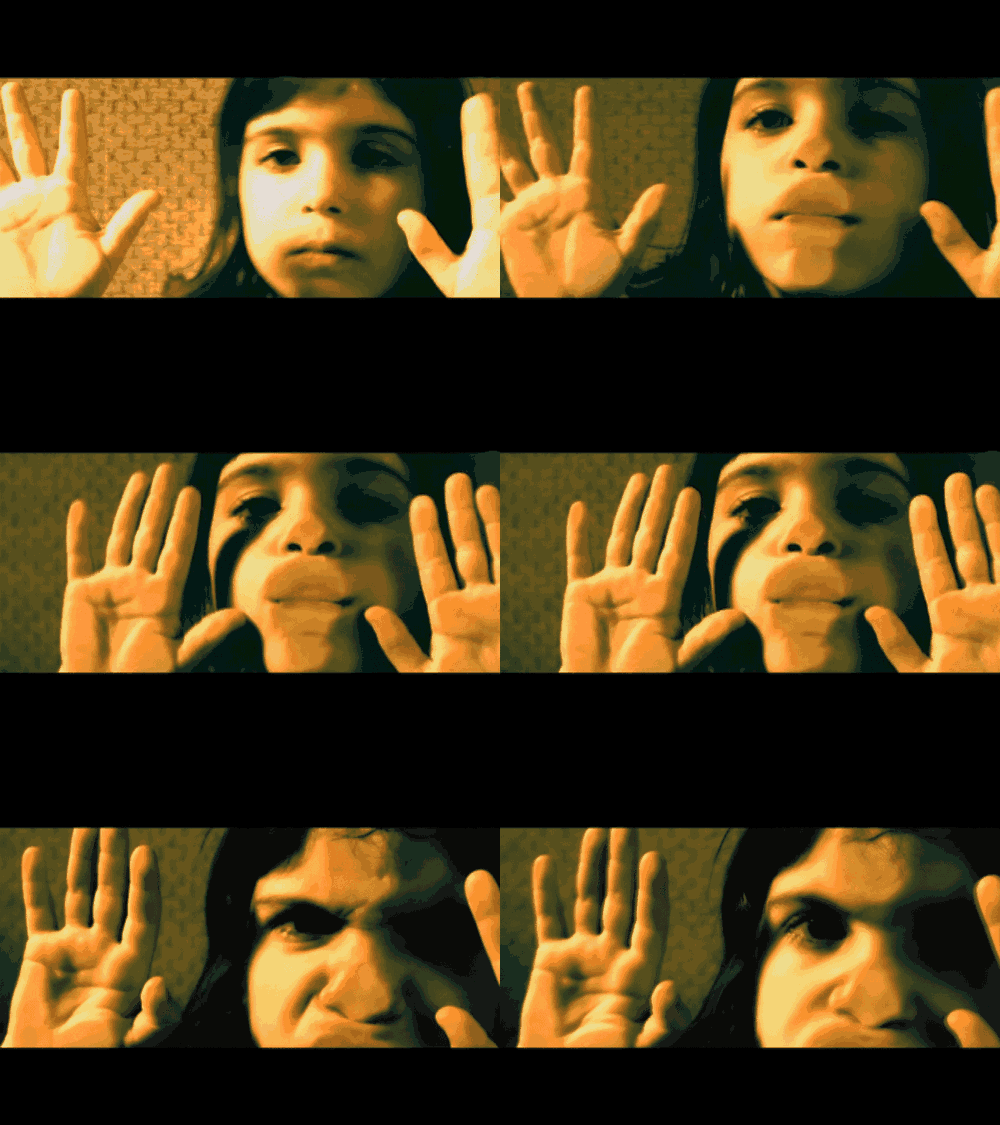
When the "dialogues" (script writer?) is being credited, Amelie is shown with a face painted on her chin pulling funny faces, as if it is talking.The costuming credit comes up after close ups of Amelie wearing a pair of cherries as earrings.The director of photography credit shows Amelie looking through large glasses with thick lenses, similar to the director of photography looking through the camera lens. The hair and makeup credits show a face painted on Amelies hand <with the gap between thumb and forefinger being a mouth> which has lipstick and eyeshadow/mascara on.

This is a cool gimmicky thing that is so obvious that it is un-obvious. I assume this was done on purpose to amuse the people who figured it out and add to the child like feeling to the shots.


Lighting and colours

Lighting and colour choices are very important to create the mood in the opening to Amelie. The lighting is the same for the whole movie practically, with a yellowy washed out tone to it. The main colours in this film are red and yellow, with some shades of green thrown in for good measure.

The yellow tone in the lighting is also introduced very early on, in the first shot of the blue bottle fly. This lighting fits with the setting , which the narrator informs you of (it is 6.28pm), so dusk would have this type of lighting. The tone in the lighting creates a nostalgic feel, even though the viewer is unsure what Amelie is nostalgic for at the time. The nostalgic feel helps set the time, as the narrators first line states that it is 1973 (soft faded tones hint to a vintage origin). It also creates good shadows and contrast with her facial features and dark hair, which appears aesthetically pleasing to the eye (rather than a harsh spotlight).

Yellow, as a colour, is introduced in the very first moment when the company titles come up in yellow on a black background. The yellow is a good contrast and makes them easily visible. Yellow is a reasonably inoffensive colour and is associated with positivity. This colour choice helps the childlike/happy mood of the opening be developed through more than one technique.

The colour green is also introduced in the narrated scene (vines on wall). These neutral/ muted tones stay like that for a bit until you get to a microscopic close up of the sperm/egg that will become the main character Amelie. This colour change indicates the importance in the scene.

Once the narration stops the main colours become a yellow/red  combination rather than  a yellow/green one. The background is yellowish, and the text is red for the first title, then it switches for a contrasting second title. Most of Amelie's toys are red or green (red cherries and paper dolls, green juice in musical glass and leaf instrument) which contrast with the washed out background. 

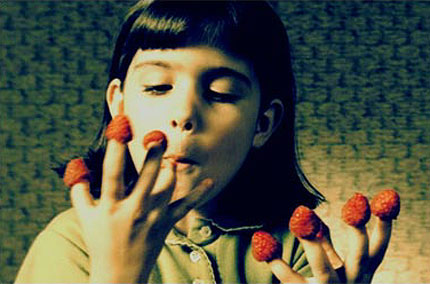
Amelie's shirt in this scene is a pale green shade, which reflects what she will wear in the future. The colours red/yellow/green are used as a main colour scheme for her wardrobe (see drawing below).

Sunday, 27 March 2011

Sound/music

The sound in the opening is a rather important feature in this opening. As mentioned in a previous posts, there is a song composed by Yann Tiersen playing at most times. Tiersen composed all the songs for this film so they all fit the movies aesthetic and mood (more fast music when dramatic things are happening, slow music when  more calm events are unfolding).The music is instrumental so it doesn't detract from the narration or what the actors are doing in the film. This type of music appeals to the French viewer because it is familiar and aids to the nostalgic feel (it may be similar to music from their childhood). Other viewers who watch with subtitles will like this music because it is so obviously 'french' and completes their foreign film experience.

 The music in the first short scene before the credits is more violin heavy than than the song playing in the credits, and it is played at a lower volume. The means it doesn't detract from the narration and the diagetic noise in the scene, which has been heightened. The diagetic noise has been heightened to enhance the idea that small things can change a persons life/fate in the long term. Because the diagetic noise is usually barely noticeable, you notice it a lot more and it shifts perception of what is happening (like when that bug gets ran over, you feel a bit sorry for it). As the song builds intensity by getting faster and adding more instruments to the work, it makes you excited for what is coming next, before it stops almost anti-climatically.

There is a shift in the music after the short narrated shots as the music becomes more focused in a montage type scene. The narration stops and the music becomes more piano based as the credits come up. This makes the viewer pay more attention to the introduction of Amelies character and what she is doing. Diagetic sound is still used, but it is less heightened than in the previous scene. This may be because when Amelie is playing she doesn't think too much about what she is doing and gets lost in a safe fantasy world so the sounds are less important. The music composed by Tiersen fits with this fantasty ideal well. The violins/accordian/piano group are written to be rather whimsical and this works with the idea that Amelie is still safe inside her childhood fantasy world even though she is now an adult (the scene with the soccer game on the roof, and the sabotage of Collignon are parrallels in this sense also). 


This music with violin is quite whimsical and that aids the idea of a fantasy world being created. Later on you in the film it is revealed that Amelie creates this world because here childhood is quite closeted, and this is how she copes. But before you know this fact, you just think she is a little girl who is off-with-the-fairies while playing listening to some pretty sounding music.

Friday, 25 March 2011

Camera movement, shot size/angle

There is a large amount of close ups ( a shot which shows a detail/expression) in the first 5 minutes of Amelie, compared to other openings that would use more mid-shots and establishing shots to introduce the settings and characters in a more obvious way. Jean-Pierre Jeunet  did the opposite of this, to introduce the movie in a slightly unfamiliar way, but still convey the ideas well.

The first shot is almost expected, an establishing shot. This shot doesn't change for a good 10 seconds, and has a low angle, like the camera has been placed on the road. It almost has the feel of a photo, as the camera doesn't move very much at all. This shot helps set the scene, as it shows a suburban area. The following establishing shot shows the Eiffel Tower in the background, immediately indicating the film is set in Paris (highlighted in the blue square on the screencap, I added this unlike the sperm circling in a previous post).

After the outdoor shots, there is a midshot of  character never mentioned again. He is introduced with a standard introduction to character (mid-shot zooming in to a close-up). This displays the characters emotions well, which is important because it is an emotional moment for him as he erases his best friend's phone number from his address book. Sticking to the normal set up makes sure the viewer understands what is happening and doesn't think 'what is up with this movie?'.
To keep them interested though, he changes this set up when introducing Amelie. The first shot you see of Amelie, is a close up of her hands. Then there is a shot of her mouth. The next shot shows her face, but it is being squished against a clear plastic/glass wall. You have to wait 30 seconds into this montage before you can get a clear view of what Amelie looks like, while wearing fruit as earrings.


This shooting style (zoomed introduction/shots) introduces the idea that small details are important to the film. Small details/chance events change Amelie's fate (in a good way) in almost a chain reaction style, so it is good that this idea is introduced early in the film.
 Detail shots are used often to reveal what the characters like which backs up the small details are important. They are what make each of the characters special and different. The most comparative detail shot is the red circle drawn around that sperm shot (I didn't notice how significant that shot was until doing this asignment and it popping up so often) and the red circle drawn around a spot/bug in the scene when Amelie is discussing what she likes. The circles used are exactly the same colour and size, and this creates a nice continuity to the films style. Midshots are also frequently used throughout the film, to add to the continuity and keep the style of the shots neat.

Editing/transitions

Amelie's opening has very strange editing compared to most other films. Closeups are used differently, and the editing style is much more rough than what contemporary viewers of today expect (seamless cuts). There is a classical editing style used for the first 10 or 15 seconds after the logos show, with text fading in and out from the center of the screen. This is followed by an expected establishing scene, but in doing this a false expectation of what is yet to come is created so the viewers are surprised (hopefully pleasantly) when the opening credits actually start.

The most obvious unusual editing style is the jump cuts and almost hand held quality to the filming. Some of the zooming is choppy and when the camera is focused on child Amelie (played by Flora Guiet) it moves a tad and changes focus slowly rather than being completley still and smooth. This aids the subject matter (a child) as you could almost imagine a child doing the editing and it ending up similar to this (but it wouldn't because the actual editors did this on purpose).

The transitions in the opening also follow this choppy style with jump cuts being used often. Light flares are also used, but they are cleverly done so it appears to be an accidental error in the film/lighting rather than something the editor did on purpose. This paired with the other home-made aspects in the opening aid the mood and put it in a class of its own compared to more classical seamless edits and openings with perfect studio lighting. These non-traditional editing techniques are used to aid the nostalgic mood Jeunet is creating. They could make people think that the movie needed a larger editing budget, but really it is placing importance on the little things in the movie once more, which is an idea raised often in the film. The small details are what makes this film and its characters special and unique from cookie cutter genre molds.

All of these editing techniques add to the quirky charm and help set the era the start of the movie is set (1970's) when Amelie is a 6/7 year old girl. The choppy cuts are used occasionally through the rest of the film, but the jumpy cuts in the opening could hint at the large jump cut/time compression when Amelie suddenly grows up.

Tuesday, 22 March 2011

Genre/ Atmosphere

In the short scene before the actual credits start, the mood is rather factual and impersonal. This is achieved by the dialogue- which uses impersonal statements, and the shots used- scientific subject matter in close-ups. The narrators tone of voice and the emphasis he uses while speaking also reinforce this mood.
Specific dates and places are used- "September 3rd, 1973, at 6.28 PM and 32 seconds... Rue St Vincent, Montmartre." "Avenue Trudaine, Paris 9" is another example of these specifics. Full names are used when people are being discussed - "Eugene Colere" and "Raphael Poulain".

 But this stiff and formal mood is lessened with the soft tone in the colours (no stark bright whites, crisp colours) and the 'paint' style of circling a specific sperm in an otherwise scientifically shot scene (most likely stock footage). The background music in the scene has been quieted, with diagetic sound being heightened (dragonfly wings beating, cars going past, bird song, eraser to paper, breathing etc). This sound effect is often  paired with zooming in on what is making the noise , to make the point of each shot clear and emphasize what is happening. This emphasis of small detail is used throughout the film, so it introduces an important idea/technique.

After that scene when the opening credits start the mood shifts to a childish/happy/quirky/nostalgic mood, with small Amelie playing and having fun. It is almost like a look back to Amelie's childhood.
The french song playing, called 'J'y Suis Jamais Alle' composed by Yann Tiersen, becomes the main sound focus, with the narration stopping. This aids the mood of the scene with its fast pace  It helps set up the soundtrack for the rest of the film, which features this music heavy with violin and piano throughout. (Listen on youtube here)

The nostalgic tone is brought in with the styling of the film, there are slight 'errors' in the lighting and the piano at the start of the scene could almost be mistaken for the piano playing at the start of a silent film. Light leaks are used through out the scene and near the end of the credits you can hear a flickering noise similar to a roll of film reaching the end of the roll, like in old movie theatres. The tones used here to make it seem nostalgic also coincide with the setting that was introduced in the mini scene earlier- 1973. The yellows and soft tones, with nice patterned wallpaper are all setting appropriate.

The lighting and softer focus used create a child like and romantic atmosphere. This sets up the films main genre- romance. The story is about Amelie falling in love in an unexpected way. The red used in the opening could be symbolic to romance (red roses, hearts, passion etc), but is used suitably so that it isn't too obvious or out of place when placed in the context of a 6 year old child playing.

The toys she plays with during the opening credits are not generic 'girls' toys such as dolls and soft toys. She is playing with almost unexpected things (fruit and dominoes) which are not typical toys per-say. This establishes the type of girl Amelie is and how she will develop both with age and as a character.
Amelie's hair and outfit is rather plain for a young girl, so this creates a false sense of what the character will be like in the movie. Although her hairstyle and costuming remain simple the character develops into someone much more complex than she appears.

Tuesday, 15 March 2011

AMELIE


The Fabulous Destiny of Amelie Poulain

I chose to do Amelie (directed by Jean-Pierre Jeunet), because I have seen it the least out of the films I chose, so I would be less likely to get sick of it during the course of this assesment. 

   Amelie's opening has a short scene, where the narrator describes things happening at a certain point in time, before it goes into the opening credits. This short scene shows small narratives of various objects/people and what they are doing, "On September 3rd 1973, at 6:28pm and 32 seconds, a bluebottle fly capable of 14,670 wing beats a minute landed on Rue St Vincent, Montmartre. At the same moment, on a restaurant terrace nearby, the wind magically made two glasses dance unseen on a tablecloth. Meanwhile, in a 5th-floor flat, 28 Avenue Trudaine, Paris 9, returning from his best friend's funeral, Eugène Colère erased his name from his address book. At the same moment, a sperm with one X chromosome, belonging to Raphaël Poulain, made a dash for an egg in his wife Amandine. Nine months later, Amélie Poulain was born." There are other moments in the film like this, and it shows how all the little details are important. This sequence also introduces the setting of the movie (Montmartre).

   The actual opening credits show Amelie as a child playing and enjoying herself, but with no other people around. This reflects her future life, as she enjoys what she does but has few companions. Red and yellow are the feature colours in the credits, and they are used often for the rest of the film. They contrasts with the other tones in the movie which are quite unsaturated/pale in comparison. This opening appealed to me because it is rather aesthetically pleasing and quirky, like the whole film. The shots used are interesting and it has a nice song in the background.


Opening Links

Amelie opening title is here on youtube (0.01 to 3.00)
This is a better quality one, but it doesn't have english subtitles.


Edward Scissorhands opening title is here on youtube (0.01 to 2.50)


Coraline title here at the Art of the Title


Breakfast at Tiffany's is here on youtube. In better quality than Amelie, even though being made 40 years earlier.

Choosing the winning opening tonight.

Sunday, 13 March 2011

Exciting first post is exciting

I have watched a few movies and have created a short list of contenders.
  • Breakfast at Tiffany's
  • Edward Scissorhands
  • Coraline
    • Amelie

    I intend to re-watch all of these starts and choose a winner. If this doesn't go to plan thanks to my indecisiveness, I will pull a movie out of a hat so I can start this project.